|
Up
Hardware
Sales/Swap
Overclockers' Forum
PC Asylum's
Price List
Hardware One
Talk to me

I got it for free at http://come.to
| |
Chaintech 6BTM
by Lester Sim (10/8/98)
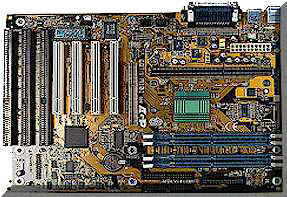
Recently I went shopping for a BX
motherboard and was pleasantly surprised with Chaintech's 6BTM. The first thing that
struck me(and probably you too) was the price. It costs about least fifty dollars less
than most of the competition. I am usually not in favour of purchasing something that is
unusually priced as this, but having read a review in Tom's Hardware site which gave this
board a pretty good rating gave me a sense of reassurance. Anyway, the extra fifty could
be invested in another 32 megabytes of SDRAM.
First, the box. It's a colourful box with the brand name Chaintech and it's logo printed
on all sides together with a catchy phrase - "We don't imitate, we innovate!".
Well, let's see what this borad can surprise us with. In the box, the usual user's manual,
ribbon cabling, a CD-ROM and the motherboard in it's anti static wrap. The motherboard
looks well made, with all connectors are placed neatly. Immediately, I notice 3 things. It
has 4 DIMM slots opposed to the many others that come with 3. Also the slot 1 for the CPU
already has the retention bracket built around it, which can be folded down for packaging
purposes. Next to the slot 1 is a tiny flexible fin, which after conferring with the
manual turns out to be the CPU temperature sensor. Very thoughtful, as this ensures that
the CPU will be in physical contact with the sensor once inserted, assuring an accurate
reading.
I plug my Celeron 266 into the CPU slot which it fits into snugly. The retention bracket
does not really hold onto the CPU cartridge as it is made for Pentium IIs but ensures that
the Celeron won't be rocked forward or backwards unduly. Under normal usage, the CPU
should not fall out. Within half an hour, I manage to setup the board up into a new ATX
casing together with my video and sound cards. The placement of the connectors on the
motherboard is quite good ensuring there is minimal cluttering of cables over the
motherboard.
The moment of truth comes as I power up the system. It beeps and the POST screen comes on,
announcing that I have a Celeron CPU running at 266 Mhz. Entering the Award BIOS setup,
there is an addional menu item which Chaintech calls SeePU features. This is a software
configuration for the CPU clock multiplier and the FSB speed. The CPU core voltage is
automatically deteced and cannot be changed which I suspect will limit the success of
extreme overclocking somewhat. The version of the BIOS software that comes with the board
orginally does not allow for overclocking, automatically detecting my FSB speed to be
66Mhz. No amount of coaxing would allow the system to go beyond 83 Mhz with the Celeron.
However, a special overclocker's BIOS update is available from Chaintech's homepage which
allows you to manually select the clock multiplier and the FSB speed. After updating the
BIOS with the latest version which allows for settings at 66/75/83/100/103/112/133Mhz with
multipliers up to 5.5x, I deceided to start experimenting. The Celeron 266 is locked at a
4x multiplier, so choosing a 100Mhz FSB would put my Celeron at 400Mhz. No problems at
that speed, the system ran smoothly without any hitches or crashes whatsoever. I slowly
increased the FSB speed to 103Mhz, then to 112Mhz at which the system refused to boot into
Windows. I have confirmed that my Celeron CPU is capable of booting up at 448Mhz on a
similarly configured ABIT BX6 / ABIT BH6 system, so that means that the limiting factor
here is probably the motherboard and not the CPU.
The limit of the motherboard's overclocking ability is easily outweighed by the
motherboard's many features. For one, the motherboard comes with a built in bootsector
antivirus software in the BIOS which Chaintech calls "ChipAwayVirus", together
with the award winning PC-Cillin v3.0 (OEM version) antivirus program for a total
antivirus protection solution. The motherboard is ACPI ready for use when a ACPI-enabled
operating system is available, supports audio SB-Link interface and WOL (Wake on LAN)
network cards.
In conclusion, the Chaintech motherboard is more of a all rounder rather than excelling in
any particular area. Motherboard comparison tests show it's performance to be very much in
the middle of the pack. However, it's plentiful features and low price should appeal to
those looking for a BX solution on a tight budget.
System Specifications:
OS: Windows 98
CPU: Intel Celeron 266Mhz (SL2QG)
Memory: Hyuandai 64Mb PC100 SDRAM
IDE: IBM Deskstar 4.3Gb
Video Card: S3 Virge DX 4Mb with Creative Blaster 3D Voodoo2 8Mb
Sound Card: Aureal 3D 128 PCI Sound Card
Motherboard Specifications:
Processor
Supports up to 450Mhz Intel Pentium II processors
Slot 1 CPU socket with retention mechanism
Supports 66/100MHz system clock speeds
Innovative SeePU technology (simple CPU installation via BIOS)
ChipSet
Intel 82440BX two chip PCIset
Accelerated Graphics Port (AGP)
DRAM Memory
Four 168-pin 3.3V unbuffered DIMM sockets
support up to 512Mb EDO (66MHz only) and
Synchronous DRAM
Provides single bit ECC capability
Boot-block Flash BIOS
Award System BIOS supports PnP, APM, DMI,
CPU throttling and Multi-device booting features
Includes Trend ChipAwayVirus
Two Ultra DMA-33 IDE Ports
Supports up to PIO Mode 4, Multiword DMA
Mode 2 and Ultra DMA-33 timings
Bus Mastering software drivers for all well-known multi-task operating systems
On Board Ultra I/O
2S(16550A compliant) + 1P(SPP/ECP/EPP) + 1FD(up to 2.88MB, 3 Mode and 1Mbps transfer rate)
Supports IrDA IR function
Two USB ports On Board
FCC Class B & CE EMI Regulation Compliant
Advanced Management Capabilities
Supports 68/75/83/103/112 MHz system frequencies for over-clocking possibility
LDCM compliant system monitoring hardware
Supports Software power off control, Override power button, Power-on by keyboard, Power-on
by modem ring, Power-on by alarm, Power failure recovery, Blinking LED in suspend
Poly-fuse overcurrent protection for USB and keyboard.
Industrywide first mainboard to combine Trend ChipAwayVirus, PC-Cillin, and Flash BIOS
protection for a 100% virus-free system boot-up
ACPI features ready when ACPI-enabled operating system is available
Supports audio SB-Link interface and WOL (Wake on LAN) network cards
All hardware designs meet PC98 requirements
Wintune 98 Results
| Area Tested |
Value |
| CPU Integer |
1122.892 MIPS |
| CPU Floating Point |
457.83 MFLOPS |
| Video(2D) |
23.79822 MPixels/s |
| Direct3D |
11.90614 MPixels/s |
| OpenGL |
7.586142 MPixels/s |
| Memory |
602.5527 MB/s |
| Cached Disk |
66.10899 MB/s |
| Uncached Disk |
2.258574 MB/s |
| CPU |
(1) Intel Pentium II with MMX@400 MHz |
| Video Board |
S3 ViRGE-DX/GX PCI (375/385) |
| Video Mode |
800x600@24bits/pixel |
| RAM |
64 MB |
| OS |
Windows 98 4.10.1998 |
Quake II OpenGL Tests
| Resolution |
fps |
| 640x480 |
69.1 |
| 800x600 |
58.1 |

13 September 1998 11:34 AM
|